The stalled Phoenix initiative underscores industrial growing pains in a critical safety sector
By Martin Kessler
As climate volatility intensifies and industrial hazards multiply across Europe, robotic firefighting systems are transitioning from experimental technology to operational necessity. These machines are increasingly viewed as vital assets in environments too dangerous for human responders. Yet Poland’s troubled Phoenix initiative has revealed weaknesses within Europe’s emerging firefighting robotics ecosystem — exposing both the sector’s potential and its structural vulnerabilities.
A High-Stakes Modernisation Effort
In 2025, Poland’s national fire service (Państwowa Straż Pożarna) launched the Phoenix programme to acquire ten advanced firefighting robots designed for extreme environments, including chemical facilities, landfill fires, and large-scale industrial incidents. The initiative, supported by European Union co-financing and structured through an international public tender, reflected broader EU ambitions to upgrade emergency response capacity in the face of climate-driven disasters and industrial risk convergence.
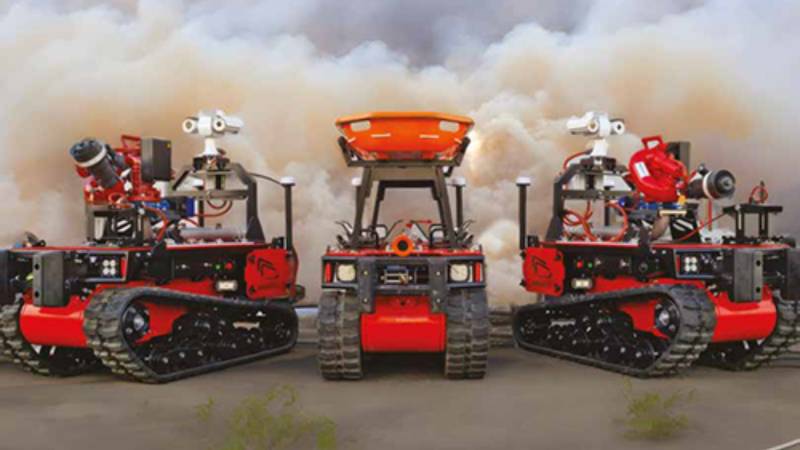
The contract was awarded to Polish supplier Kadimex Sp. z o.o., which proposed delivering the TEC800 robotic platform manufactured by France-based Angatec. The system reportedly featured remote operation capability, thermal imaging systems, foam projection units, and reinforced mobility for debris-laden terrain. The total contract value exceeded 16 million złoty (approximately €3.7 million), with full delivery expected by the end of 2025.
Delivery Delays and Contract Fallout
By early 2026, official procurement records indicated that only three of the ten units had been delivered and formally accepted. Despite deadline extensions and financial penalties, the remaining robots were not supplied within contractual timelines. The contract was partially terminated due to non-performance.
Such outcomes carry serious consequences under EU procurement regulations. Companies found in substantial breach of public contracts may face temporary exclusion from future tenders — a safeguard designed to protect public funds and maintain integrity in state-backed projects. While Kadimex, as the contracting party, bears direct responsibility, the episode also raises broader questions about manufacturing capacity and readiness within Europe’s robotic firefighting supply chain.
Escalating Demand for Robotic Support
The timing of the Phoenix setback is significant. Europe has endured record-breaking wildfire seasons in recent years. In 2022 alone, more than 785,000 hectares burned across EU member states — more than double the previous decade’s annual average. Industrial fires in recycling facilities, chemical plants, and waste depots have also increased.
Robotic systems offer tangible advantages in such conditions. They can operate in toxic atmospheres, withstand extreme heat, and navigate unstable terrain while reducing risk to human crews. Several European nations have begun integrating robotic platforms into their emergency strategies. France notably deployed a firefighting robot during the Notre-Dame Cathedral blaze to access structurally compromised zones.
However, widespread adoption remains limited. Dedicated robotic fleets are rare, and Phoenix was among the few coordinated efforts to expand deployment at meaningful scale. Its disruption therefore highlights a deeper challenge: the gap between technological promise and industrial reliability.
A Fragmented Industrial Landscape
Unlike established sectors such as aerospace or automotive manufacturing, firefighting robotics in Europe remains a relatively young and fragmented field. Many suppliers are small to mid-sized engineering firms with constrained production capacity. Demonstration units frequently appear at trade exhibitions, yet scaling those prototypes into reliable, multi-unit deployments has proven difficult.
Industry observers note that Angatec itself emerged following the restructuring of a predecessor firm that encountered delivery challenges in prior municipal contracts. While legal entities may change, product lines and technical teams often overlap — raising questions about continuity in performance history and accountability.
Should procurement bodies evaluate a product’s operational track record beyond the legal identity of its manufacturer? And should EU-funded buyers have improved access to supplier performance data across borders? These are questions increasingly relevant as robotics moves from pilot projects to core infrastructure.
Procurement and Oversight Considerations
The Phoenix case also underscores the complex role of distributors in high-tech public procurement. While Kadimex was contractually responsible for delivery, the manufacturing process relied on Angatec’s production capacity. Yet procurement frameworks did not appear to require detailed scrutiny of the manufacturer’s prior performance metrics or industrial scaling capability.
As Europe prioritises technological sovereignty and resilience in strategic sectors, transparent mapping of supply chains — especially where public funding is involved — may become essential. Emergency response systems occupy a critical intersection of civil protection, industrial safety, and national resilience.
Innovation Ambition vs. Production Reality
There is an inherent tension in public-sector innovation procurement. Governments seek cutting-edge solutions, yet emerging technology firms may lack the industrial depth required for rapid, multi-unit production. Delivering ten highly engineered robotic systems within a compressed timeframe demands robust manufacturing infrastructure, quality assurance systems, and supply chain reliability.
In some cases, winning a large public contract can strain a young company’s operational capacity, exposing financial limitations or immature production processes. The Phoenix episode illustrates that technological capability alone does not guarantee delivery readiness.
The Road Ahead for Robotic Firefighting
Despite setbacks, the case for robotic integration in firefighting remains strong. The EU’s rescEU framework has identified robotic assets as a priority category for future shared procurement. Countries including Germany and Finland are exploring modular platforms designed for adaptability across multiple hazard scenarios.
Going forward, clearer performance standards, training protocols, and certification benchmarks may be necessary. A Europe-wide validation framework — comparable to those in aviation or medical devices — could help public authorities distinguish between demonstration-stage technology and production-ready systems. Standardised testing would also enhance buyer confidence and encourage industrial maturity.
Growing Necessity, Growing Pains
Poland’s Phoenix initiative was ambitious — and ambition is often necessary when confronting escalating climate and industrial risks. Yet its complications reveal a broader reality: robotic firefighting in Europe is still in a formative phase.
As wildfires intensify and industrial incidents grow more complex, robotic systems will likely become indispensable partners to human responders. For that transition to succeed, Europe will need not only advanced machines, but stronger procurement oversight, industrial scaling capability, and transparent performance accountability.
In short, the future of robotic firefighting depends as much on systems governance as on engineering innovation.